A Memory. A Warning.
By August Haug
(In memory of Conti †)
I have grown old, and my thoughts return more and more often to that time in Africa.
It was 1984, in The Gambia — that narrow country on the west coast of Africa known as the “Smiling Coast.”
Back then, I was a traveler between worlds.
I loved Africa — its endless vastness, its wild animals, and the people who owned little yet carried great dignity and warmth within them.
Their hospitality did not come from wealth, but from the heart.
I often walked alone along the shore.
The African sun lay heavy and warm upon my skin, and the wind carried the salty breath of the Atlantic across the land.
For hours I watched the seagulls rise effortlessly into the sky — free, untethered — as if they belonged to a world still in balance.
The waves roared so deeply that I could hear their rhythm even in my sleep.
There was something cleansing about diving into the cool Atlantic waters, swimming out into the shallow bay where colorful fish and coral shimmered beneath the surface.
There was a certain magic about Africa.
Somehow, I felt I had arrived.
The beaches were barely touched. There was no mass tourism, no vast hotel complexes — only simple lodgings and open horizons.
I will never forget that time.
It was on a hot afternoon that I met him.
An old African man sat in front of his modest hut.
His hair was white and tightly curled, like clouds gathering before a distant storm.
His face was marked by time, yet his eyes held a depth that had seen more than words could tell.
I sat down beside him on the hard, dusty ground.
Between us lay the silence of Africa.
We spoke for a long time about the world.
Then he said quietly:
“They are taking everything from us.”
There was no anger in his voice. Only certainty.
“They cut down the forests to build roads.
They tear open the earth to search for stones that are more valuable to them than life itself.
They do not see the animals.
They do not hear the voices of nature.
They do not feel the pain of the earth.”
He gazed out toward the sea, as if he could see something there that remained hidden from me.
The wind moved gently through the dust at our feet.
“Too many will come,” he said.
“And with them, greed will grow.
Nature will slowly die.
Many animals and plants will disappear forever.
The seas will become sick, and the fish will die.
Yet mankind will continue to take, as if there were no tomorrow.”
His voice grew softer, more reflective.
I fell silent.
His eyes glowed — not with rage, but with a deep and sorrowful knowing.
The gulls cried above us, and the ocean roared as if carrying his words away.
Then he looked at me directly.
And in a quiet yet unwavering voice he said:
“The sky will open its gates.
Waters will come and take what man has built.
Fire will sweep across the land.
Forests will burn. Fields will turn to ash.
And man will realize that he is not the master of this earth — only its guest.”
His voice nearly disappeared into the sound of the sea.
But I understood every word.
In 1984, the world still seemed strong and unshakable to me.
His words felt distant — almost unreal.
I was young.
I believed in permanence.
But today, decades later, I know:
The old man was not speaking of his future.
He was speaking of ours.
And sometimes, when I see images of burning forests,
dying animals,
rising waters,
and an unsettled world,
I see his face again.
And I wonder
whether we have ever truly learned to listen.
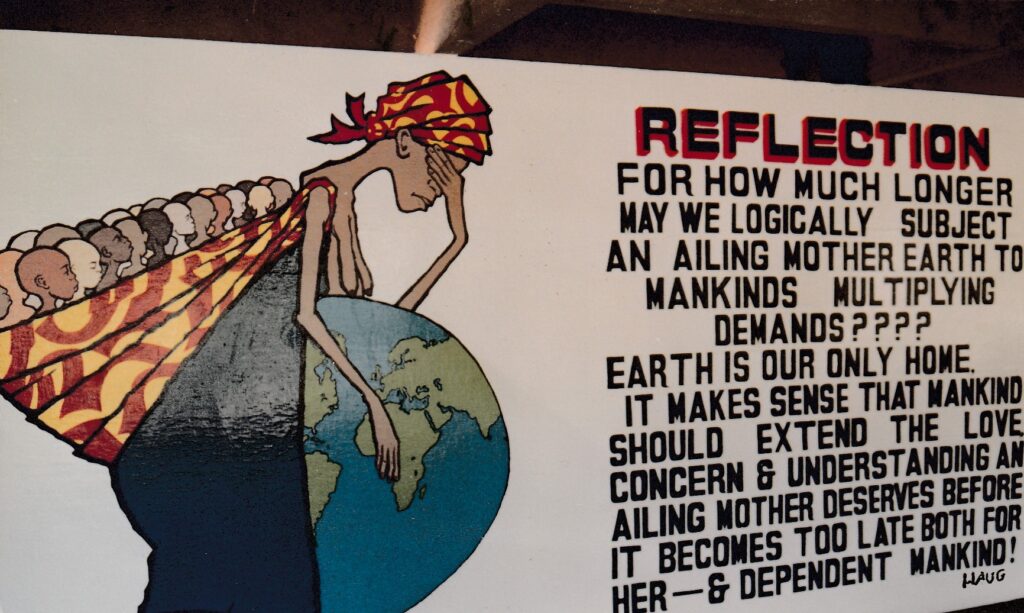
He went into his hut and returned with a wooden board, paints, and brushes.
“I will paint. You will write my words,” he said.
I watched as he painted a woman — Mother Earth.
Upon her back she carried people of every origin, every color.
Somewhat awkwardly, I began writing his spoken words beside the image.
He painted in silence. I watched in fascination.
When he finally laid down his brushes, I had finished writing his warning.
Under the African sun, the painting dried quickly.
“We will hang it at the entrance of the small hotel,” he said.
The next day, it was hanging there.
I took a photograph.
I never saw the old man again.
Nor did I ever see the painting again.
Only the photograph remained.
And his warning.
Today, decades later, I understand that his words were true:
Great droughts.
Vast floods destroying entire regions.
Massive wildfires consuming forests.
Heat pressing like lead upon cities.
Extreme cold and overwhelming snowfall.
Today we call it climate change.
He called it irresponsibility.
The old man’s name was Conti.
He is no longer alive.
I never saw him again.
But his face, his eyes, his words —
I will never forget.
I write this story in memory of Conti †.
Perhaps it is not too late.
But we would finally have to listen.